Architech, the software factory, built for reliable enterprise software. Built open, works with the model provider you trust.
Claude Code, Codex and Cursor collapsed idea to working code.
Anyone on your team can write code now.
Production-grade software comes down to three things. A coding agent on its own gives you none of them.
Specs, tests, a fresh reviewer and merge policies around every change, from intent to production.
The agent writes the code. You still carry the plan between sessions, rerun the tests and read every diff. Each prompt to review cycle takes days, and nothing you correct carries over to the next session.
Architech is the orchestrator that runs yours: intent goes in, tested and reviewed changes come out, with a record at every step.
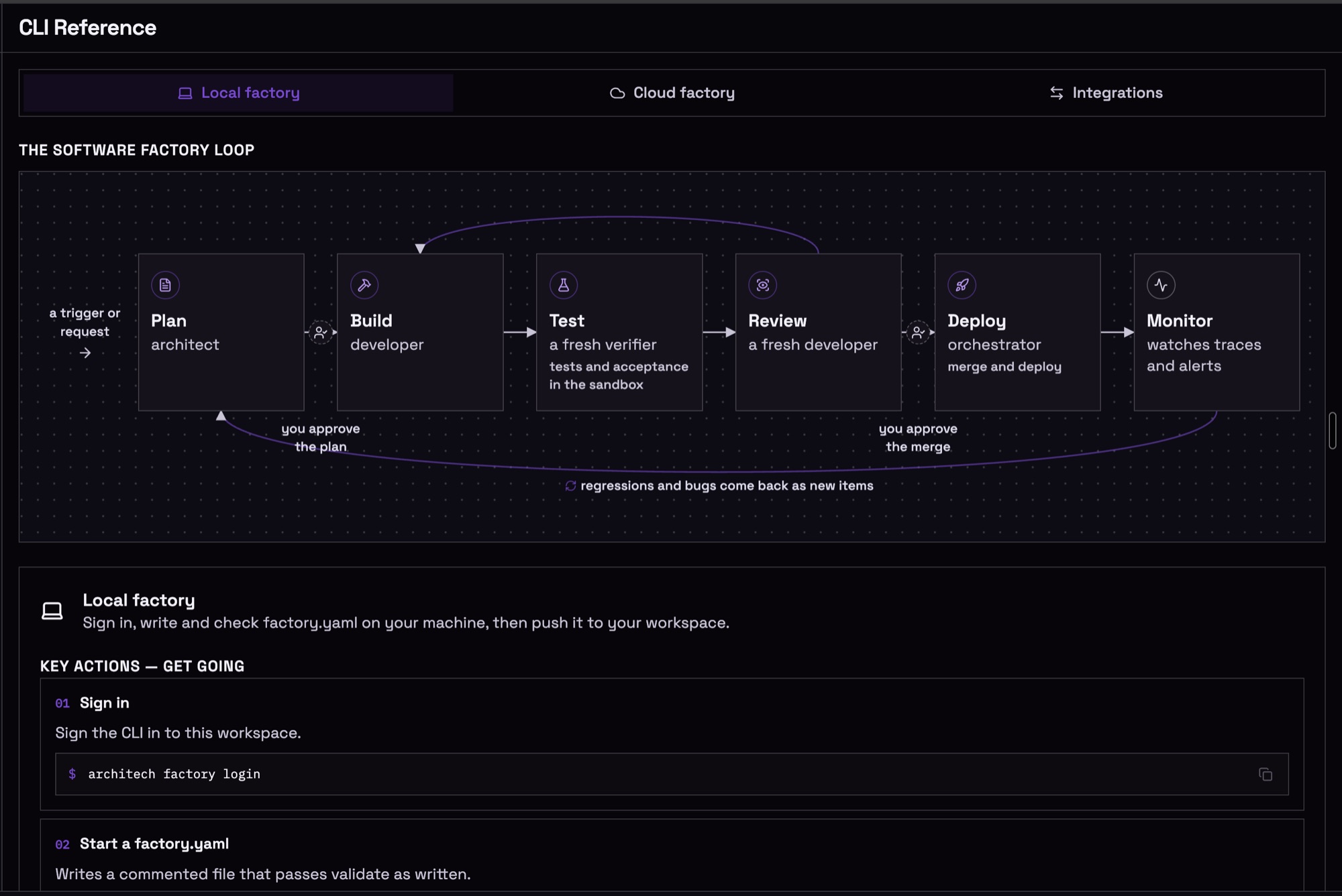
Plan, build, test, review, ship and monitor, orchestrated. One orchestrator and a team of agents with fixed roles, shared rules and repeatable workflows.
A spec with acceptance criteria, a test-first build loop, a fresh reviewer that checks the diff against the spec, CI gates, and a PR that says what it read, decided and why.
Anyone plans, everything lands on one board. Orchestrators pick the work up and build in parallel waves, on your machine or always on in the cloud.
Run Architech in your repo today. Push one factory.yaml and the same factory runs always on in the cloud.

80 board items · 8 active · 1,898 PRs merged
Write it once with /onboard, run it locally, push it to the cloud when you are ready. Local and cloud runs share the same file.
metadata: { id: shop, repos: [acme/shop-web, acme/shop-api] } boards: linear: { team: SHOP, statusMap: { triage: Triage, done: Done } } github: { labels: { ready: factory:ready, risk: risk:* } } autonomy: calibration # calibration · standard · auto agents: architect: { provider: anthropic, model: opus, effort: high } developer: { provider: mistral, model: devstral, effort: medium } reviewer: { provider: openai, model: gpt, effort: high } stages: test: { extend: [e2e-acceptance] } review: { external: [security-scanner] } merge: { staging: yolo, e2e: as-ready, prod: on-approval } orchestrator: escalate: [risk:high, new-table, spec-ambiguous] decide: [naming, refactors, test-gaps] limits: { sandboxes: 4, usd_per_task: 25 } triggers: - { on: board.status=Triage, start: spec } - { on: github.ci-failed, start: build } routines: - { every: mon 07:00, run: "patch upgrades, one PR" } notify: - { to: slack:#eng, on: [plan.ready, escalation] } - { to: github, on: [pr.opened, run.done] } sandbox: { preset: node-22, install: [pnpm, playwright] }
Every factory starts from the same roles, rules, workflows and gates. /onboard reads your repos, asks about what it cannot see, and customises the blueprint, so the factory builds your kind of software your way.
factory.yaml/onboard
scans the repos, interviews you, writes the files
Framework conventions, end-to-end tests in a browser sandbox, preview deploys per PR.
API contracts first, additive migrations only, integration tests against real services.
Cross-compile toolchain in the sandbox, hardware test rigs as an external stage, your coding standard as rules.
Simulator tests, pipeline checks, one product context at the root and rules per package.
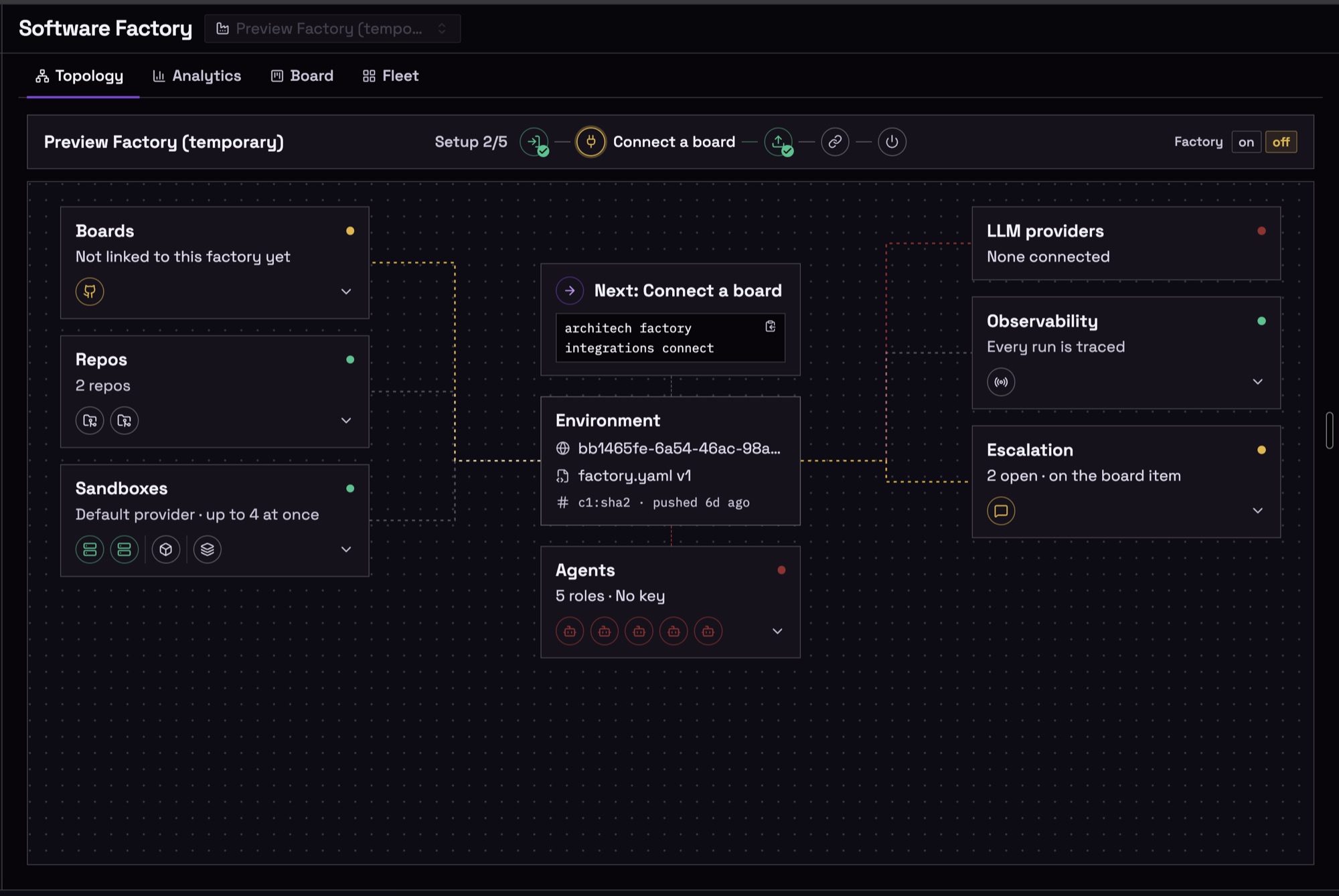
Push factory.yaml and enable it. From then on the factory runs always on: in sandboxes, on your models, against your boards, with every run traced.
architech factory push→architech factory enablethe same file your local runs use
Push factory.yaml, turn the factory on, then see what it reads, what it costs and where every item stands. Read-only for now: the cloud views are for observing.
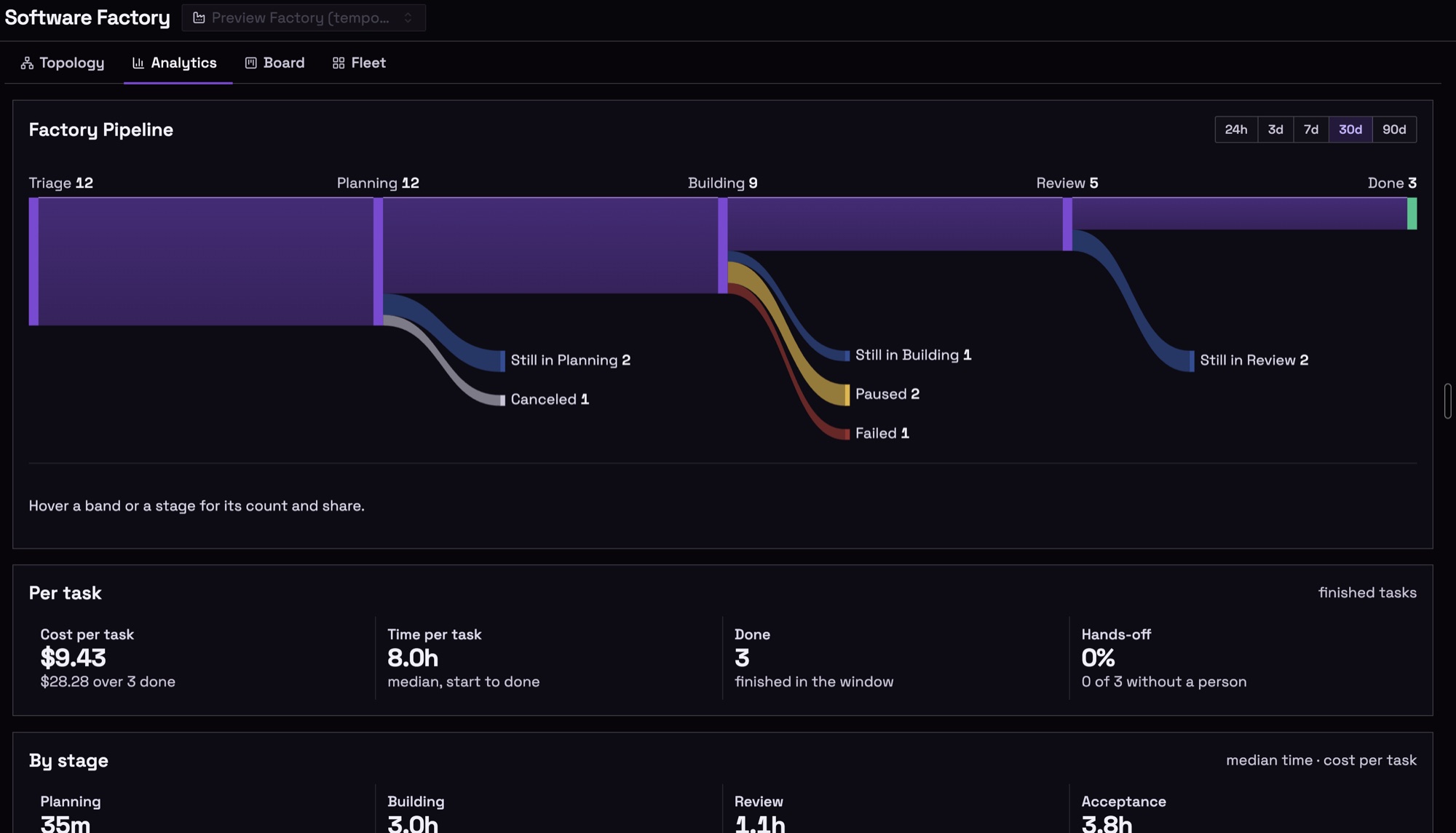
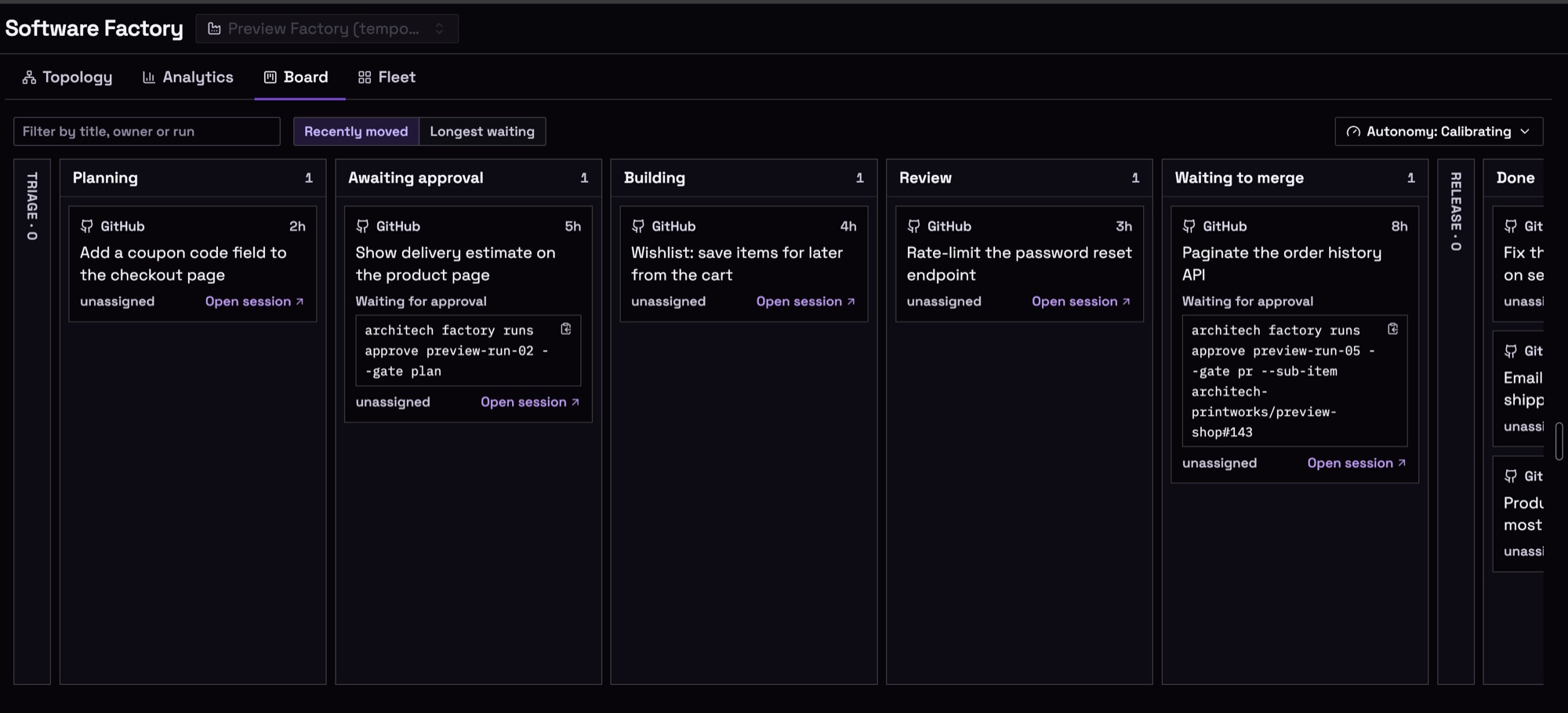
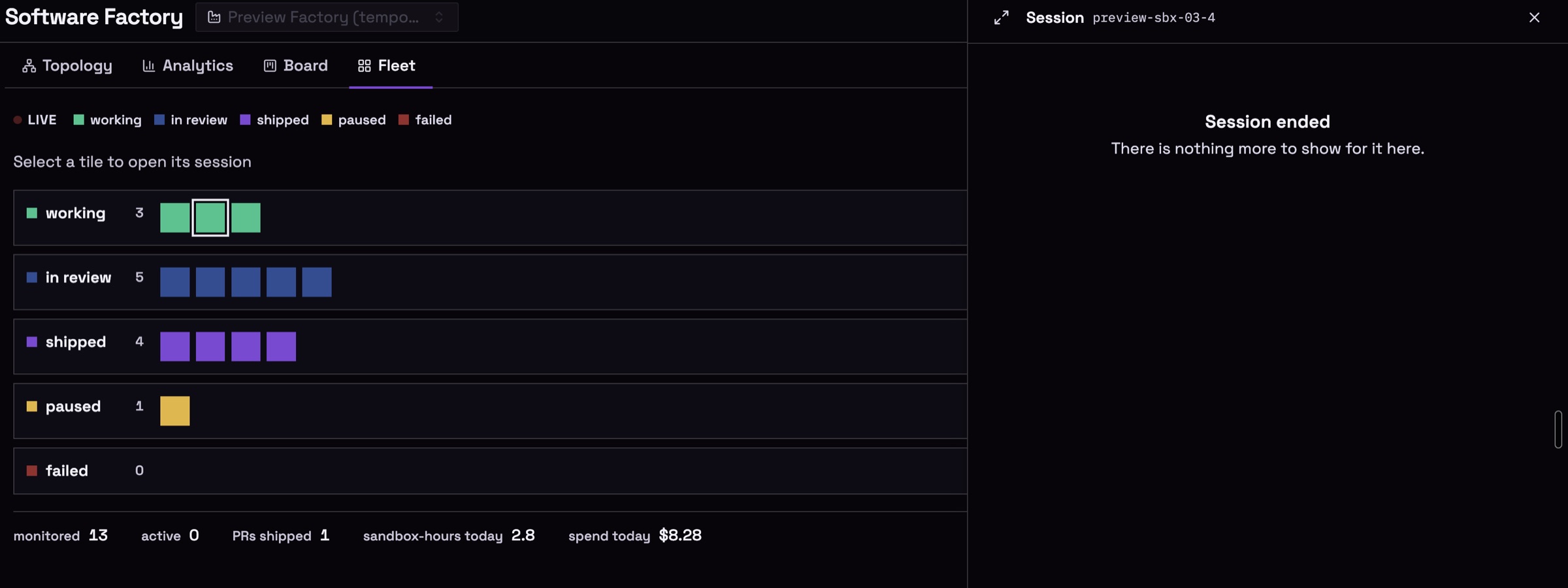
Start with every gate on. Raise the autonomy tier as the factory earns it, and set a merge policy per environment.
Every plan and every merge waits for your approval while the factory learns your codebase and your taste.
The orchestrator decides routine calls alone and asks a person only when risk or complexity says so.
Auto-ship, monitor and triage. A regression comes back as a hotfix, without waiting on anyone.
No black box and no lock-in. Your factory is plain files in your repo, running on the models you choose.
Bring your own key. Pick the provider, model and effort for every role, and keep them under the contracts you already have.
One factory.yaml and Architech runs on your machine, against your repos and boards. The cloud is a choice, not a requirement.
Rules, principles and memory are markdown in your repo. The factory never rewrites your AGENTS.md or CLAUDE.md.
Every stage runs in its own sandbox with your tooling preset, under caps on parallel sandboxes and spend per task.
Issues, PRs, decisions and their why, with every run traced. Audit any change months later.
Approval gates on plans and PRs, merge policies per environment, and an autonomy tier you raise only when trust is earned.
Architech is the factory behind our own product. It built Mutagent’s MVP, our agent factory, and the cloud infrastructure Architech itself now runs in.
A 30-minute working session. Bring a real ticket from your backlog: we plan it with the factory, and you see the spec, the waves and the first PR come together live. No commitment.
Markdown is the new software. Agents, skills, commands and workflows are files: versioned, reviewed and diffed like code. One framework, linked into every repo instead of copied.